BIRD CALLS and SONGS
A blog about the bird sounds of eastern North America and beyond using original recordings and sonagrams.


...The eccentric Piccolo brothers were, like their cousin, talented and very unproductive intellectuals. The elder, Casimiro, took months to paint a picture of goblins in a style influenced by Arthur Rackham, while Lucio spent thirty years composing but never managing to complete a Magnificat in the style of Malipiero. In the 1950s the younger brother decided to publish his poems, Canti barocchi, which won a literary prize in Lombardy, an unexpected achievement that turned his cousin Giuseppe competitive and impelled him to write The Leopard. “Being mathematically certain”, he wrote, “that I was no more of a fool [than Lucio], I sat down at my desk and wrote a novel.”

Why the Female Ghosts appear unto Ulysses, before the Heroes and masculine spirits? Why the Psyche or soul of Tiresias is of the masculine gender; who being blinde on earth sees more then all the rest in hell; Why the Funerall Suppers consisted of Eggs, Beans, Smallage, and Lettuce, since the dead are made to eat Asphodels about the Elyzian medows? Why since there is no Sacrifice acceptable, nor any propitiation for the Covenant of the grave; men set up the Deity of Morta, and fruitlesly adored Divinities without ears? it cannot escape some doubt...What Song the Syrens sang, or what name Achilles assumed when he hid himself among women, though puzling Questions are not beyond all conjecture...

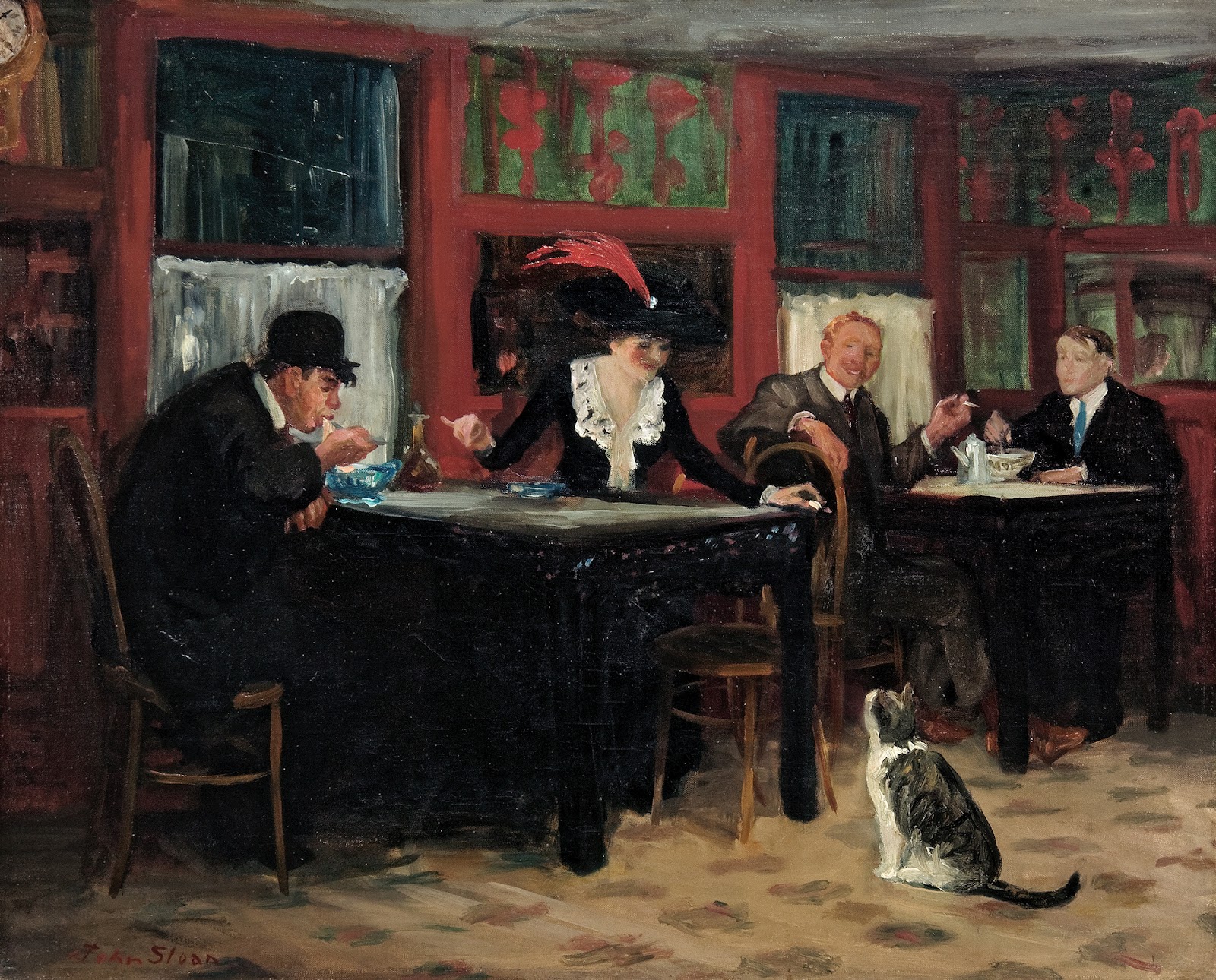
John Sloan (American, 1871–1951)
Chinese Restaurant, 1909
Oil on canvas; 26 x 32 1/4 in. (66 x 81.9 cm)


I reread Evelyn Waugh’s Sword of Honour trilogy, and three Ivy Compton-Burnett novels, though later I can’t remember which ones. I read a new biography of Catherine of Aragon in proof. I read On Being Ill, by Virginia Woolf. What schoolgirl piffle, I think. It’s like one of those compositions by young ladies mocked in Tom Sawyer. I can’t understand what she means when she complains about the ‘poverty of the language’ we have to describe illness. For the sufferer, she says, there is ‘nothing ready made’. Then what of the whole vocabulary of singing aches, of spasms, of strictures and cramps; the gouging pain, the drilling pain, the pricking and pinching, the throbbing, burning, stinging, smarting, flaying? All good words. All old words. No one’s pain is so special that the devil’s dictionary of anguish has not anticipated it. There is even a scale you can use to refine it: ‘Tell me,’ the doctor says, ‘on a scale of one to ten, how much this hurts’: one being a love bite, I suppose, and ten the fiery pit of hell. Pain may pass beyond language, but it doesn’t start beyond it. The torture chamber is where people ‘speak’. No doubt language fails in that shuttered room called melancholia, where the floor is plush and the windowless walls are draped in black velvet: where any sound you make carries only feebly to the outside world, and can be taken for some accidental, natural sound, a creak or a sigh from doorframe or drawer. But then, mental suffering is so genteel; at least, until the dribbling sets in. Virginia only has decorous illnesses. She has faints and palpitations, fevers and headaches, though I am mindful that at one stage they tried to fix her by pulling out her teeth. But she is seemly; she does not seep, or require a dressings trolley, she does not wake at dawn to find herself smeared with contact jelly from last night’s ECG. Virginia never oozes. Her secretions are ladylike: tears, not bile. She may as well not have had bowels, for all the evidence of them in her book...








 out & about