Tuesday, December 06, 2005


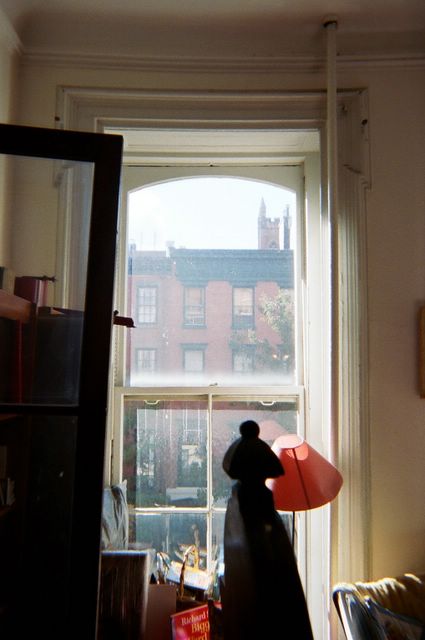
View of the the carillon of the Theological Seminary from my Chelsea bed just as the sun hit. Posted by Picasa

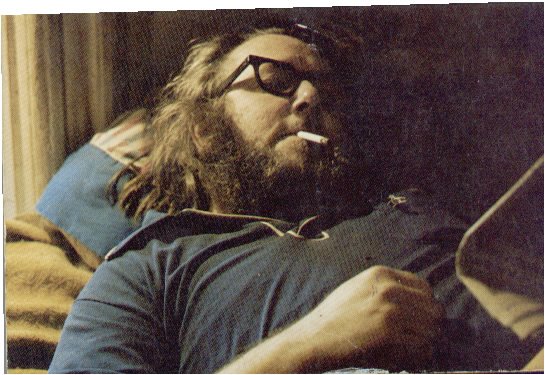
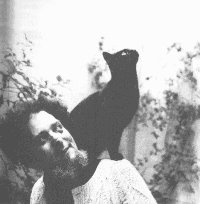
Harewood wordsmith K. Davies (of the popular "Goatman" thrillers) at Stephen King's house in Bangor, Me. Posted by Picasa

Beaver Memorial in Bangor, Maine. Posted by Picasa

watching Sideshow Bob's peerless houseboat solo performance of Pinafore on the Simpsons last night made me come over all D'Oyly Carte, with bitter regrets for my non-existent career in light opera, further deepened this morning by the perusal of this very thorough Gilbert and Sullivan Homepage. My long-suppressed fondness for G&S much stoked a few years back by Mike Leigh's "Topsy-Turvy", as good a film about the process of artmaking as any I can think of. Lovely ending, with the wonderful Scottish actress Shirley Henderson playing Leonora Barham (above, with Sybil Grey and Jessie Bond) as Yum Yum in the original production The Mikado singing (to a mirror) one of my favorite songs--

"Yes, I am indeed beautiful! Sometimes I sit and
wonder, in my artless way, why it is that I am so much
more attractive than anybody else in the whole world. Can this
be vanity? No! Nature is lovely and rejoices in her loveliness.
I am a child of Nature, and take after my mother.


The sun, whose rays
Are all ablaze
With ever-living glory,
Does not deny
His majesty--
He scorns to tell a story!
He don't exclaim,
"I blush for shame,
So kindly be indulgent."
But, fierce and bold,
In fiery gold,
He glories all effulgent!

I mean to rule the earth,
As he the sky--
We really know our worth,
The sun and I!

Observe his flame,
That placid dame,
The moon's Celestial Highness;
There's not a trace
Upon her face
Of diffidence or shyness:
She borrows light
That, through the night,
Mankind may all acclaim her!
And, truth to tell,
She lights up well,
So I, for one, don't blame her!

Ah, pray make no mistake,
We are not shy;
We're very wide awake,
The moon and I!"


 Posted by Picasa

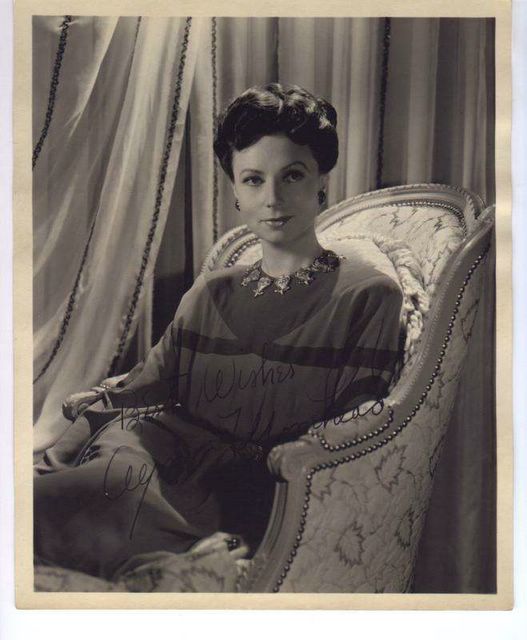
happy birthday Agnes Moorehead, perhaps best known as Endora on "Bewitched", but whose performance as Fanny Minafer in Orson Welles' "Magnificent Ambersons" is one of cinema's best--


 Posted by Picasa

Monday, December 05, 2005


Seattle Doin's--

PRESS RELEASE

WHAT: Action Books! reading @ the Jewelbox
WHO: Joyelle McSweeney (Alabama), Johannes Goransson (Alabama), Don
Mee Choi (Seattle), Kreg Hasegawa (Seattle)

WHERE: Jewelbox Theater at the Rendezvous: 2322 2nd Ave. / Seattle,
WA (Bell Town) / 206-441-5834
WHEN: Dec. 10th (Sat.), 7:30 pm
HOW MUCH: Free
CONTACT: Kreg Hasegawa
gerky@earthlink.net
206-661-4110

BIOS:

JOYELLE MCSWEENEY is the author of The Red Bird and The Commandrine and Other Poems, both from Fence Books. She writes for The Constant Critic and teaches in the MFA program at the University of Alabama. She recently co-founded Action Books with Johannes Goransson.

JOHANNES GORANSSON was born in Sweden but now he lives and teaches in Tuscaloosa, AL. The most recent issues of the journal Fourteen Hills and the on-line journal Typo_feature his selections of innovative
Swedish poetry from the the past 100 years. Remainland: Selected
Poems of Aase Berg is now out from Action Books, and Ideals
Clearance by early Finland-Swedish Modernist Henry Parland is
forthcoming from Ugly Duckling Presse.

DON MEE CHOI lives in Seattle and translates the poetry of
contemporary Korean women poets. Her forthcoming books of
translations include When the Plug Gets Unplugged_(Tinfish 2005) and
Words of Anxiety (Zephyr Press, 2006). More translations of Kim
Hyesoon's poetry are scheduled to be published by Action Books, 2007.
>
> KREG HASEGAWA lives in Seattle. He occasionally puts on readings such as this. He usually doesn't book himself to read but Joyelle twisted
his arm. He writes stories. They have been published in The News, Sal Mimeo, Spring Formal, and Greetings. He apologizes to the poetry
community for not getting out much lately, but he's in graduate
school. He hopes no one has taken this personally. He wishes
everyone well.

MORE INFO:

Johannes Goransson and Don Mee Choi will be reading translations of
Aase Berg and Kim Hyesoon, respectively. Here is some information on
them.

AASE BERG is one of the most celebrated yet subversive young poets in
Sweden. She has published four books: With Deer, Dark Matter,
Transfer Fat and Uppland. She has recently given reading tours of
the US and the former Yugoslavia, and her work has been translated
into several European languages. She is currently translating the
complete works of H.P. Lovecraft into Swedish.

KIM HYESOON (Kim Hye-sun) is one of the most prominent poets in South Korea. She teaches creative writing at Seoul College of the Arts. Kimis the first woman to receive the coveted Kim Su-yong Poetry Award.
Her books include Seoul, My Upanishad, Poor Love Machine,
Calendar Factory, Factory Supervisor, Please Look and A Cup of Red
Mirror. She also writes feminist literary criticism.

ABOUT ACTION BOOKS: Action Books is for poetry that goes too far. We started this press in the spirit of internationalism, and to that end
we are publishing both emerging American poets and contemporary poets in translation. Our debut volumes, available now on


www.actionbooks.org and www.spdbooks.org , are:

The Hounds of No, an entirely unheimlich debut by Lara Glenum,
whose blog of the same name has gained a wide following in the blog
world, and whose debut volume Claudia Rankine has called "morbidly brilliant" and K. Silem Mohammed has called "zoologically savage."


My Kafka Century, a bristling and brainy second volume by Arielle
Greenberg, whose work Publishers Weekly has called "both slippery and
sharp, like ice skates in use."

Remainland, a selection of disarmingly visceral miniatures from the
internationally acclaimed Swedish poet Aase Berg. Lisa Jarnot has
characterized Remainland as "a place of weird music and visceral
delight."


Posted by Picasa
the Shelley Berman revival continues...

Sunday, December 04, 2005

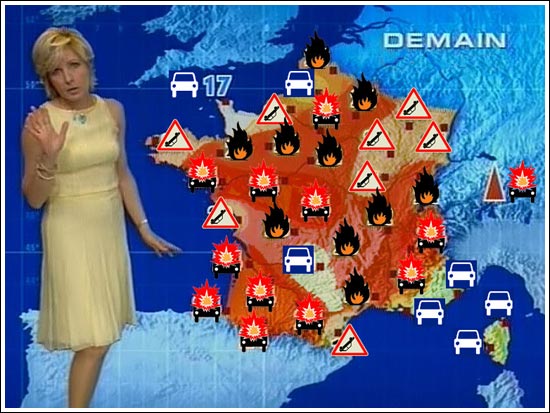
Deaths from international terrorism compared with road crash deaths in OECD countries

"In the 29 OECD countries for which comparable data were available, the annual average death rate from road injury was approximately 390 times that from international terrorism. The ratio of annual road to international terrorism deaths (averaged over 10 years) was lowest for the United States at 142 times. In 2001, road crash deaths in the US were equal to those from a September 11 attack every 26 days."

Friday, December 02, 2005

second issue of new Vancouver art tabloid The Fillip Review just arr'd over the transom & seems lively so far--articles by poet Donato Mancini, Lorna Brown, Aaron Peck, Lawrence Rinder on Richard Tuttle &c &c--& you have have to love a magazine whose statement of principles opens with a quote from Kevin Davies' "Karnal Bunt"....


a history of the Pineapple--

"Beauman calculates that once all the costs of a pinery are considered -- a stock of costly pineapple plants and pots and a glasshouse to contain them, a 40-foot stove to heat the glasshouse, a garden boy to tend the stove full-time -- the expense of a single English-raised pineapple in the second half of the eighteenth century was about 80 pounds, or 5,000 pounds in today's money. No wonder a single pineapple was often made to last for some time, "passed on from party to party until it began to rot so much it smelt out the whole household". By Victorian times, one horticulturalist claimed he had heard of a "single pineapple going the round of west-end dinner parties for some weeks". Beauman does not mention a similar assertion which I have come across elsewhere, that poorer middle-class families would even take to hiring pineapples for occasions when they wished to entertain, in order to appear grand, praying that no one would actually attempt to cut a slice."

Posted by Picasa

Diary from Paris

"We shouldn't always expect a riot to mean something. There's been a carnival air about some of the destruction in France, and as anthropologists know, the meaning of carnival is to be found in the ordinary days of the calendar. The crudest question seemed simply to be whether there was anybody out there. Would anyone who wasn't the descendant of a Maghrebi or sub-Saharan migrant living in abject conditions be willing to acknowledge the existence of these conditions and the people afflicted by them? But with that came a threatening message about mistaken or ill-assigned identity that briefly clarified the cities like a flare over an earthworks: "we will become the people you imagine we are, just watch." It is the defensive-aggressive strategy that Sartre discerned in Genet's ostentatious criminality."


(photo--merci I.P.)

Posted by Picasa

Thursday, December 01, 2005


"Bridge Construction-Morris, IL - 2003
oil on canvas" by Randy Dudley, whose "panoramic realist" view of the Gowanus Canal, reproduced in this month's "Art in America" was a striking view of a beloved landscape. I wish I could have seen the show.

"This landscape suggests, through its layering and overlapping of debris, structures, and accumulated rubble, a visual record of the past and present. This synthesis of histories is what gives the landscape its vitality. Gone are the stockyards, tanneries, steel mills, and gas works replaced by numerous smaller concerns, all of which leave behind their trace to the historic mix.

The industrial landscape, by virtue of its isolation, seems to resist change. This same isolation creates a menacing and alien landscape to some. But the inherent beauty of reflected light and local color combine with a stillness that permeates everything, creating a unique and inspired environment."

 Posted by Picasa

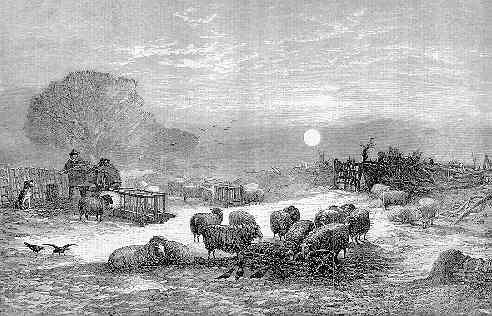
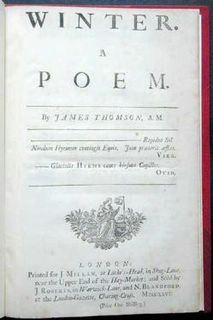
from another seasonal favorite, James Thomson's "Winter, A Poem"--I was obscurely hurt by John Ashbery (such a tender Clare devotee) describing Thomson's "Seasons" as "bland" in his otherwise admirable review of the Collected Kenneth Koch in Publisher's Weekly, but surely bland like good chewy oatmeal with cinnamon and walnuts rather than cream of wheat with skim milk and equal? My sentimental attachment to Thomson (another overweight underproducer, the Scot who wrote Rule Brittania & made The Castle of Indolence look easy!) precludes such judgement...

"FOR, see! where Winter comes, himself, confest,
Striding the gloomy Blast. First Rains obscure
Drive thro' the mingling Skies, with Tempest foul;
Beat on the Mountain's Brow, and shake the Woods,
That, sounding, wave below. The dreary Plain
Lies overwhelm'd, and lost. The bellying Clouds
Combine, and deepening into Night, shut up
The Day's fair Face. The Wanderers of Heaven,
Each to his Home, retire; save those that love
To take their Pastime in the troubled Air,
And, skimming, flutter round the dimply Flood.
The Cattle, from th'untasted Fields, return,
And ask, with Meaning low, their wonted Stalls;
Or ruminate in the contiguous Shade:
Thither, the houshold, feathery, People croud,
The crested Cock, with all his female Train,
Pensive, and wet. Mean while, the Cottage-Swain
Hangs o'er th'enlivening Blaze, and, taleful, there,
Recounts his simple Frolic: Much he talks,
And much he laughs, nor recks the Storm that blows
Without, and rattles on his humble Roof."

 Posted by Picasa

a must-read--Harper, Bush Share Roots in Controversial Philosophy

"The Calgary School has successfully hidden its program beneath the complaint of western alienation. "If we've done anything, we've provided legitimacy for what was the Western view of the country," Calgary Schooler Barry Cooper told journalist Marci McDonald in her important Walrus article. "We've given intelligibility and coherence to a way of looking at it that's outside the St. Lawrence Valley mentality." This is sheer Straussian deception. On the surface, it's easy to understand Cooper's complaint and the Calgary School's mission. But the message says something very different to those in the know. For 'St. Lawrence Valley mentality,' they read 'the Ottawa-based modern liberal state,' with all the negative baggage it carries for Straussians. And for 'Western view,' they read 'the right-wing attack on democracy.' We've provided legitimacy for the radical-right attack on the Canadian democratic state, Cooper is really saying."


 Posted by Picasa

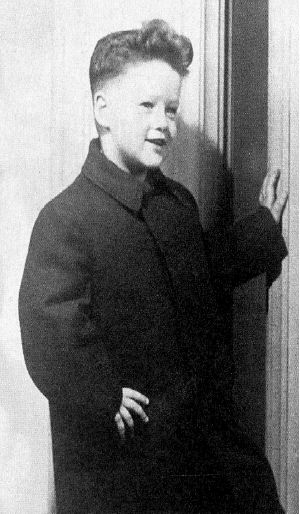
Gary Indiana has an interesting review of "Brokeback Mountain" in this week's "Voice", but I'd missed or forgotten his sprited July 2004 defense of Bill Clinton's My Life--

""Regarding "My Life" itself, it is long. Yes. While I doubt that any of the reviewers who have disparagingly compared it to the memoirs of Ulysses S. Grant have ever actually read the latter, I also doubt that they have read the former. Say what you will about Clinton, but he is one of the few U.S. presidents since Grant to have written a book by himself. While reading it I often wished someone else had written it for him, since he clearly has a tin ear and little sense of what to include and what to leave out. All the same, it's impossible to actually read this book without missing Clinton, for unlike his predecessor and his successor, the Spook and the Born-Again Cokehead/Booze Hound, he isn't mean-spirited, homophobic, racist, or idiotic, never confuses himself with Jesus Christ, and even when putting annoying people in their place, does it with a light touch. "Unfortunately, my relationship with Bill Bennett didn't fare well after I became President and he began promoting virtue for a living." "Vice-President Dan Quayle said he intended to be the 'pit bull terrier' of the election campaign. When asked about it, I said Quayle's claim would strike terror into the heart of every fire hydrant in America." Clinton is even gracious to Barbara Bush, a vicious old bag in pearl sets who could've given Angela Lansbury notes for her role in The Manchurian Candidate."

 Posted by Picasa

"19 November 2005, Asematunneli
Sanna (14) and Nina (14)

"We are going to a meeting of j-pop fans. Our style idols are Japanese artists like Mana-sana. It's easy to find nice clothes but they are too expensive. We like to shop at Backstreet and Morticia. We are wearing this chain because we are friends."


via Metafilter HEL LOOKS, devoted to the remarkable street fashion of Helsinki...


 Posted by Picasa

Wednesday, November 30, 2005


from William Cowper's The Winter Morning Walk, a poem I always think of, my first walk in the snow, any given year--


"The verdure of the plain lies buried deep
Beneath the dazzling deluge; and the bents,
And coarser grass, upspearing o'er the rest,
Of late unsightly and unseen, now shine
Conspicuous, and, in bright apparel clad
And fledg'd with icy feathers, nod superb.
The cattle mourn in corners where the fence
Screens them, and seem half petrified to sleep
In unrecumbent sadness. There they wait
Their wonted fodder; not like hung'ring man,
Fretful if unsupply'd; but silent, meek,
And patient of the slow-pac'd swain's delay.
He from the stack carves out th' accustom'd load,
Deep-plunging, and again deep-plunging oft,
His broad keen knife into the solid mass:
Smooth as a wall the upright remnant stands,
With such undeviating and even force
He severs it away: no needless care,
Lest storms should overset the leaning pile
Deciduous, or its own unbalanc'd weight...."

 Posted by Picasa

short piece on Mike Kelley doesn't get into the new show, unfortunately, but good anyway--


"I make art," Kelley once said, "in order to give other people my problems."

 Posted by Picasa

From below The Orient, Ayr, as the website has it

"Opened in 1932. Bingo since 1983, then a nightclub, now derelict.
Originally had atmospheric interior; this has been lost."

Across the bridge and across the street from the Carnegie Library--had a very lux interior, blue carpeting with gold flecks but I probably misremember. Was cheaper than the Odeon and there was a threepenny discount for the first eight rows, where I still like to sit.

Posted by Picasa

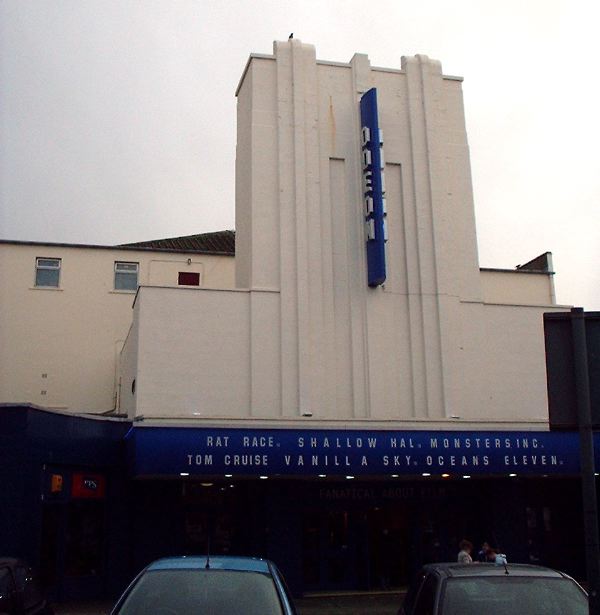
the Odeon in Burns Square, Ayr, fromCinemas in Scotland, subdivided into four now but surviving, saw many movies here, was memorably evacuated from it during a showing of the Rod Steiger "Napoleon", when someone phoned in a bomb scare--'71?? Dad nipped into the pub across the square for a quick one but we were back in our seats in less than half an hour.
 Posted by Picasa

Tuesday, November 29, 2005


Happy Birthday William Blake!

from America: A Prophecy--

"Washington, Franklin, Paine, and Warren, Gates, Hancock, and Green
Meet on the coast glowing with blood from Albion's fiery Prince.
Washington spoke: `Friends of America! look over the Atlantic sea;
A bended bow is lifted in Heaven, and a heavy iron chain
Descends, link by link, from Albion's cliffs across the sea, to bind
Brothers and sons of America; till our faces pale and yellow,
Heads depress'd, voices weak, eyes downcast, hands work- bruis'd,
Feet bleeding on the sultry sands, and the furrows of the whip
Descend to generations, that in future times forget.'
The strong voice ceas'd; for a terrible blast swept over the heaving sea:
The eastern cloud rent: on his cliffs stood Albion's wrathful Prince,
A dragon form, clashing his scales: at midnight he arose,
And flam'd red meteors round the land of Albion beneath;
His voice, his locks, his awful shoulders, and his glowing eyes
Appear to the Americans upon the cloudy night."

Posted by Picasa

thoughtful Ted Berrigan recollections at fait accompli, whose Nick Piombino I met, a fellow floater, amidst the swirl and light of the Mike Kelley show at the Gagosian a couple of weeks back--

"Berrigan was talking about the fact that when we read contemporary poetry there is an *electric* (instantaneous) quality to our contemporary way of reading that is unique to our era. He used Ashbery's Tennis Court Oath as an example. He was saying that we don't stop to think about each word the way we read poetry now. We engulf the pages instantaneously, ravenously. As he spoke about this, he kept pulling on the chord of the electric light hanging from the ceiling over and over turning excitedly turning it on and off. He made me realize that when we read poetry now we read with the speed of light, the speed of thought, so it should be written and presented with this factor in mind. His Sonnets helped make this an era of lightning fast poetry, He also spoke of the loss of nobility in poetry as well, so he was aware of the price that we might be paying for this type of insatiability. But I think he, and the New York School in general, did much to counter the mournful tones of so much 20th Century poetry: ("I grow old, I grow old, I will wear the bottom of my trousers rolled... I have seen them singing each to each...I do not think that they will sing to me")"


 Posted by Picasa

Monday, November 28, 2005


looking forward to Chris (DaVinci) Haddock's Intelligence (with Ian Tracey, pictured) on CBC tonight.

"His goal, Haddock says, was "to do something we don't see much of, which the Brits tend to do, which is an espionage thriller. The Americans do it, but it's often quite cliched; they do an exaggerated action-adventure approach to it. I thought the genre of real espionage thrillers was really unexplored and it would be something fresh.

"I think there's an appetite for it. Just worldwide, you have everybody questioning the sources of information and veracity of information."

Moreover, he envisioned Intelligence as being told from "not the top down but from the bottom up."

Haddock hopes by doing so he can create the sort of topical, potentially incendiary drama that generates conversation " not just thrills " among audience members. Specifically, he references the films of the 1970s " movies that reflected the Watergate era. ""


Posted by Picasa

The Problem With Emily Dickinson from

"Elements of Literature for Christian Schools," by Ronald Horton, Donalynn Hess and Steven Skeggs (Bob Jones University, 2001)

"Several of her poems show a presumptuous attitude concerning her eternal destiny and a veiled disrespect for authority in general. Throughout her life she viewed salvation as a gamble, not a certainty. Although she did view the Bible as a source of poetic inspiration, she never accepted it as an inerrant guide to life."

 Posted by Picasa

Saturday, November 26, 2005


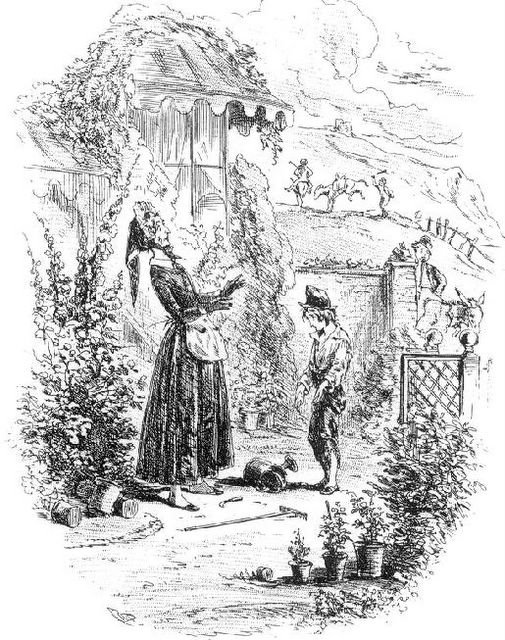
"My shoes were by this time in a woeful condition. The soles had shed themselves bit by bit, and the upper leathers had broken and burst until the very shape and form of shoes had departed from them. My hat (which had served me for a night-cap, too) was so crushed and bent, that no old battered handleless saucepan on a dunghill need have been ashamed to vie with it. My shirt and trousers, stained with heat, dew, grass, and the Kentish soil on which I had slept - and torn besides - might have frightened the birds from my aunt's garden, as I stood at the gate. My hair had known no comb or brush since I left London. My face, neck, and hands, from unaccustomed exposure to the air and sun, were burnt to a berry-brown. From head to foot I was powdered almost as white with chalk and dust, as if I had come out of a lime-kiln. In this plight, and with a strong consciousness of it, I waited to introduce myself to, and make my first impression on, my formidable aunt."

watching George Cukor's great David Copperfield on TCM, how much of movie/text/illustration (as in many cases hopelessly conflated in my mind) was gone, what came back & in what form, intense moments utterly unrelated to narrative, those donkeys on the cliff, Freddie Bartholomew--my Dad's nemesis--and the milestones...


 Posted by Picasa

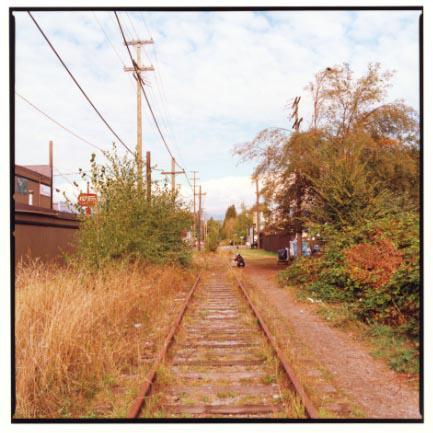
from Mark Mushet at Tyee a very nice set of images (in the warm Burns Bog fire light) of Vancouver's abandoned Arbutus Line--

"The CPR acquired what became known as "The Arbutus Line" from the Vancouver & Lulu Island Railway in 1901. Until 1958, the line was leased to the BC Electric Railway (BCER), which ran passenger services from Vancouver to Steveston. In its time, BCER "Interurban" cars carried people from downtown Vancouver to Steveston. But by 1958, all across North America, rails were replaced by rubber and, eventually, the gridlock we know and love today."

Posted by Picasa

decent Georges Perec piece--Eng. translations of his books gladly all back in print, including Gilbert Adair's "A Void". I was very pleased to meet M. Adair at Lee Ann & Tony's salon, though too shy to subject him to quizzing about one of the most virtuosic translations attempted since Urqhart's Rabelais, let alone his "Love and Death on Long Island". Maybe next time!

Posted by Picasa

Friday, November 25, 2005

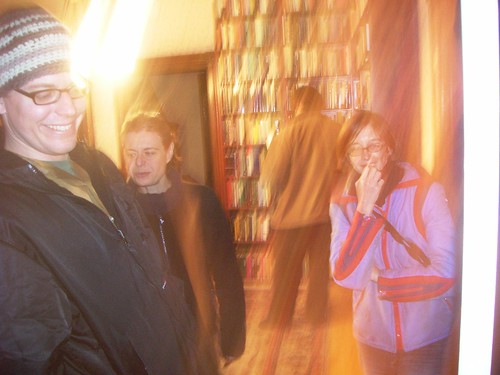
David "Spider" Perry, Carla Billeteri, Me & Monica Fauble in Bangor last week


, originally uploaded by Mongibeddu.

I'm the one gazing wistfully at Ben & Carla's magnificent shelves. Many more of Ben's great pix inside.

Thursday, November 24, 2005

George Monbiot

"But we shouldn't forget that the use of chemical weapons was a war crime within a war crime within a war crime. Both the invasion of Iraq and the assault on Falluja were illegal acts of aggression. Before attacking the city, the marines stopped men 'of fighting age' from leaving. Many women and children stayed: the Guardian's correspondent estimated that between 30,000 and 50,000 civilians were left. The marines treated Falluja as if its only inhabitants were fighters. They levelled thousands of buildings, illegally denied access to the Iraqi Red Crescent and, according to the UN's special rapporteur, used 'hunger and deprivation of water as a weapon of war against the civilian population'.

I have been reading accounts of the assault published in the Marine Corps Gazette. The soldiers appear to have believed everything the US government told them. One article claims that 'the absence of civilians meant the marines could employ blast weapons prior to entering houses that had become pillboxes, not homes'. Another said that 'there were less than 500 civilians remaining in the city'. It continued: 'The heroics [of the marines] will be the subject of many articles and books ... The real key to this tactical victory rested in the spirit of the warriors who courageously fought the battle. They deserve all of the credit for liberating Falluja.'"

Tuesday, November 22, 2005


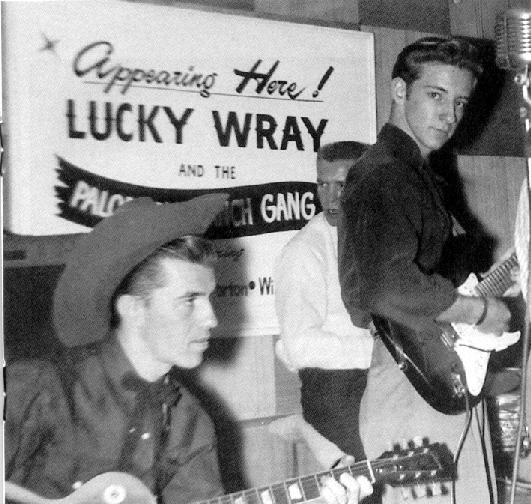
farewell Link Wray (1929-2005). On arrival home a choking fog & now this bad news. I'll be back once a good breeze clears out the valley. Meanwhile: crank it up, daddy.


 Posted by Picasa