What would we do if we believed women were equal human beings, with as much right to determine their life story as men? How would we view the world differently?

It turns out that in eight states, plus the District of Columbia, getting beaten up by your spouse is a pre-existing condition.
Under the cold logic of the insurance industry, it makes perfect sense: If you are in a marriage with someone who has beaten you in the past, you're more likely to get beaten again than the average person and are therefore more expensive to insure.
Landscape with Satellite Dish
Nothing ever seemed to happen in Springfield;
there was never anything good on TV.
Then the newsflash came through about the bomb.
Lisa stopped trying to electrocute Bart
to watch. ‘Looks like we’re in deep doo-doo,’
said Homer, going to fix himself a snack.
The hairs stood up on the back of Grandpa’s neck—
all thirteen of them. Who would save Springfield?
There was nothing anyone could do
except sit and keep watching TV.
By the fourth ad-break Homer was bored.
Who cared anyway about some stupid bomb?
‘Didn’t Professor Frink make a bomb-
defusing robot?’ asked Bart. Yes, but there was a snag:
it kept blowing up. A tearful Marge bared
her soul to the cowering shoppers of Springfield—
‘We could lose everything, even TV’—
and hid the family savings in her hairdo.
Then Homer had an idea, chewing his do-
nut—let Mr Burns take care of the bomb.
That weirdo! He didn’t even have a TV.
Homer got on the phone to Burns, snug
in his fallout shelter, and hollered: ‘Save Springfield!’
Now he was thirsty, and headed off for a beer
at Moe’s. Jasper was crying into his beard
at the bar: soon he’d be as dead as a dodo
and nothing would remain of dear old Springfield
but roaches and fallout, all because of the bomb
some two-bit punk was using to cock a snook
at folk like him and get some time on TV.
Burns was on the job though. Of course he watched TV;
he’d staged the whole thing to help him sweep the board
at the Oscars with his new film Sneak
Attack, a Wellesian thriller. ‘Think of the dough
I’m going to make,’ he chortled to Smithers. The bomb
was a hoax—what a lucky escape for Springfield!
TV announced the news to the people of Springfield.
Bored again, Homer forgot all about the bomb
and sneaked to the fridge for a beer. It was empty. Doh!
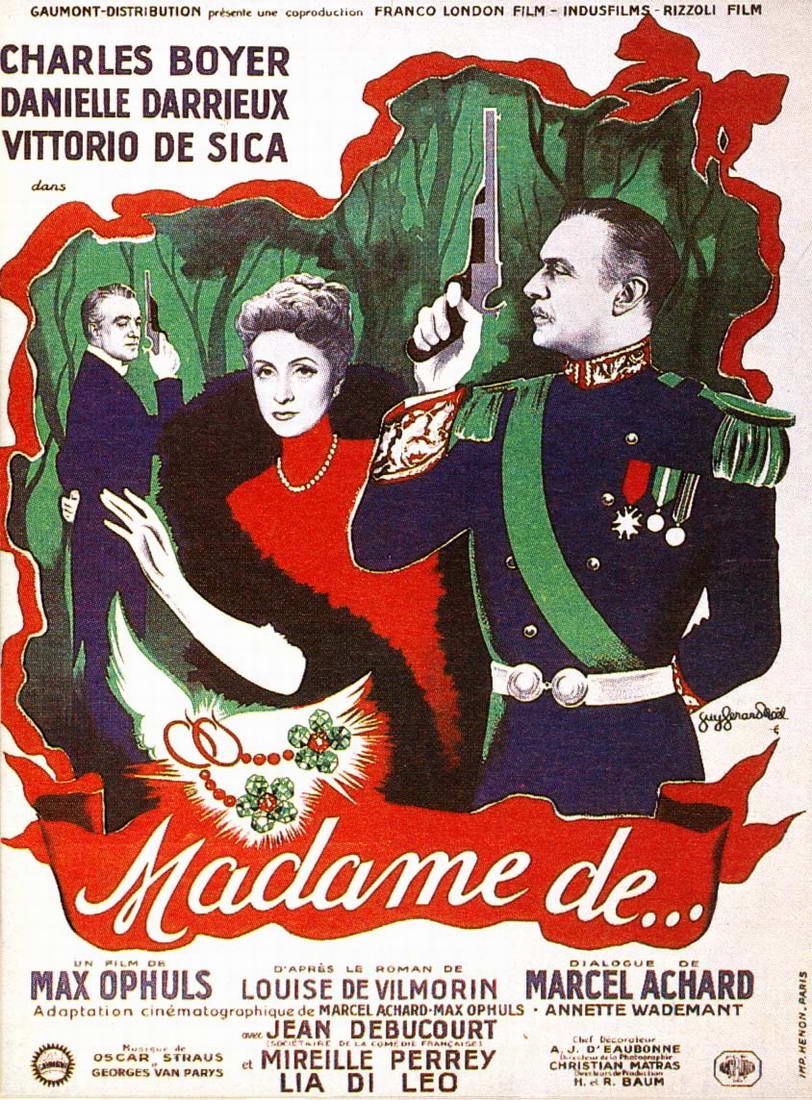
Evanescence is an integral part of cinema, and no other director captured it as lyrically and yet as savagely as Ophüls. His tracking, dollying, gliding camera was never more mellifluous, or his visualization of life's inexorable flow more tangible, than in The Earrings of Madame de…: The dissolving ballroom twirls between the Countess and the Baron form possibly the most graceful invocation of the passage of time ever depicted on screen, while a transition from the fluttering pieces of a love letter to snow falling outside brilliantly conveys the slender line separating the incandescent from the sepulchral in a world marked by transience...
A human being experiences a rose as a lovely, familiar shape, a bright, beautiful color and a sublime scent. That is the very definition of a rose. But to a dog? Beauty has nothing to do with it; the color is irrelevant, barely visible, the flowery scent ignored. Only when it is adorned with some other important perfume — a recent spray of urine, perhaps — does the rose come alive for a dog.

The weather forecast invariably appears in the bottom left-hand corner of The Shillong Times's front page, always in a little green-tinted box, always with the same lack of specificity: "Rainfall is likely to occur over most areas in Meghalaya, Arunachal Pradesh, Assam, Nagaland, Manipur, Mizoram and Tripura in the next 24 hours."
Perhaps it was one of my suggestions, though no doubt I told Jonathan that North Tynedale was even lovelier, besides chance—since cottages are not often empty in such a landscape—that fixed him here to the great advantage of Dent and Sedbergh, overlooking the extravagant meanderings of the Dee and patterns of bracken on the fellside opposite, without close neighbours unless you count the natty red weasel that lives at the side of his waterfall or a score or so of monosyllabic sheep. What better neighbours could a laconic poet wish for?
(thanks Don Share)


Nowhere to Go (1958) onTCM tomorrow afternoon...
Among the many pleasures of watching the film is the evocative black and white cinematography of Paul Beeson which gives us a crook’s tour of London complete with back streets, dive bars, shabby flats and seedy neighborhoods. A downbeat mood of desolation and overwhelming loneliness is further driven home through the film’s score which is composed and performed by jazz musician Dizzy Reece and his quintet; it remains the jazz trumpeter’s only film score to date. In addition, James Bond fans will get a kick out of seeing Bernard Lee – four years before his appearance as “M” in the series beginning with Dr. No (1962) – as the ruthless and
completely loathsome villain of the piece...
The common accusation that the artist shows no evidence of having lived in the real world with other human beings is kind of offensive but largely baffling. What I see pouring out of Tarantino's films is a great love for people, the arts, stories and life itself. His is a profoundly uncynical cinema; even the artifice is completely sincere. I'm looking at my DVD shelves, trying to think of another filmmaker more in love with people, their speech, their faces, their reasons, and the list is miniscule; Tarantino's films are just so jazzed about spending time with their characters (and his actors) that the screen is crowded with affection...

For the Vehicule reading, Gerry pasted pages of poetry across the wall of the space. As the poems were pasted at eye height, he walked along the wall, reading. His poems were... recordings of his thoughts, inner conversations, reflections, self-centered but always in the moment, always coming back to the poem he's thinking, writing. Many of his poems are only a few words, a phrase, out of context, comic aphorisms, a "translation" of Basho's haiku, or the "independently coined" phrase PRONDL, from the "automatic gearshift on your car". His reading is sometimes conversational, sometimes forced out one syllable at-a-time. He was suave, with silk scarf, moustache and sideburns. 1978 and very much alive. Gerry Gilbert...

“She’s quite talented,” said Jamie Hogan, owner of BearVault, based in San Diego. “I’m an engineer, and if one genius bear can do it, sooner or later there might be two genius bears..."
He was told by custody officers that the pencils were valued at £500,000 and that he had damaged "the concept of a public artwork titled Pharmacy ... valued at £10,000,000". Cartrain is on bail and, if convicted, his actions will feature among the highest value modern art thefts in Britain. The box of pencils – a very rare "Faber Castell dated 1990 Mongol 482 Series" – will be put back by Hirst, although the installation is no longer on public display.
But that is not the end of it. Police also arrested Cartrain's 49-year-old father, who they suspected of harbouring the pencils...
American universities are exemplary here: they are less racist and sexist than they were 40 years ago and at the same time more elitist. The one serves as an alibi for the other: when you ask them for more equality, what they give you is more diversity. The neoliberal heart leaps up at the sound of glass ceilings shattering and at the sight of doctors, lawyers and professors of colour taking their place in the upper middle class. Whence the many corporations which pursue diversity almost as enthusiastically as they pursue profits, and proclaim over and over again not only that the two are compatible but that they have a causal connection – that diversity is good for business. But a diversified elite is not made any the less elite by its diversity and, as a response to the demand for equality, far from being left-wing politics, it is right-wing politics...

Keep it personal, I tend to think—so, lovely flashes of memories, of this dear person. Like time he was doing TV children's program, the loping monster spider they could hardly freak out at it was so benign. Viz., himself. I love the shy excitement of his voice, the particularity with which he catches to consonants. Likewise his eyes, of a faded flashing blue. He's got a great beard now, reddish, a kind of Anglo-Scots Santa Claus.
He's always been good to me, god knows. Times he was restless and couldn't sleep nights in early days Vancouver, he'd drop in and we'd drink and talk, round and around. He told me once that something like two generations of his family had had the same English teacher in grammar school—grounds for life in one place, surely. He's often a bird who seems to be sitting on the roof for awhile, just looking down with bemused regard for those below.
When he moves, language, body, mind and eye, I get a sense, even a whiff, of some post-gun-powdery smell. Which is so good, quick, to the nose. He's a very fast, sweet perceiver, the sweet Jesus of local streets. No cross ever finally necessary. Or, as he would say, "save the postage & come yourself!"
Well, standing here in the wings, so to speak, could put it, "Ladies and Gentlemen, welcome to the greatest show on earth," which is , after all the distractions, human , and right here and now. You're going to love it, because it loves you. So—ticket's in your hand, eye's in your head, ear's in your body. Let's go.
Placitas, New Mexico
August 22, 1976
"We are aware that in relation to certain aspects of the case there are a number of uncertainties and qualifications," the judges wrote. "We arealso aware that there is a danger that by selecting parts of the evidence which seem to fit together and ignoring parts which might not fit, it is possible to read into a mass of conflicting evidence a pattern or conclusion which is not really justified."

“There you are deserted by him in whom you have placed all your faith. We are alone. Women tortured by fate, betrayed by all men. Where can we turn except to the heart and the understanding of another woman who knows what you are suffering? I feel for you. I suffer with you. I want to help you. Let me stand by your side in your fight for justice and compassion in a world made by men and for men...”


In 1956, at the age of thirteen, I went into a suburban record store and bought a copy of “Since I Met You Baby,” by Ivory Joe Hunter. This was an Atlantic record. I had heard “Since I Met You Baby” sung over the radio, but I had not seen a copy of the record. It was my sense of the situation, when I saw the record in the suburban record store, that to buy and then to own it would be a potent experience. I looked at the record jacket. On one side, there were depicted little stick people playing little stick instruments. On the other side, there were sketched portraits of Atlantic’s principal artists. There was a portrait of Ruth Brown (her eyes slightly slanted, her hair in a mysterious upswept arrangement I had never seen on any living woman), Joe Turner (mouth open, full mustache, little black bow tie), LaVern Baker, Clyde McPhatter, Ray Charles (a small pencil thin mustache and dark glasses), and the Clovers. Ray Charles, in his sketch, had been given the suggestion of a neck. The heads of the others floated on the jacket. The heads of the five Clovers floated together in a way that suggested no possible physical grouping. The names of the artists were printed in red under the black sketches. Black and red were at that moment the Atlantic colors. Across the top of the side of the jacket where the sketches appeared, there was the name “ATLANTIC,” in big black type. Under that was “Leads the Field in Rhythm & Blues,” in black type of a size slightly more modest. Under the sketches, at the bottom, in red script, were the words “And Many Other Exclusive Artists.” There was nothing on this record jacket that did not excite my interest. I was interested in the strange upswept hair of Ruth Brown, in the dark glasses of Ray Charles, in the little black bow tie of Joe Turner. I thought it would be a very strong thing to Lead the Field in Rhythm & Blues. I was interested in the Other Exclusive Artists. I felt, with some poignance, that this record—not just the song but the record, and not just the record but the jacket of the record—held some information that I needed to have. I felt, in fact, a certain pain, and even a certain anger. I felt pained that there was important information of great power of which I had no idea. I felt anger because I sensed that this information had been withheld from me deliberately...