Thursday, December 01, 2005


"19 November 2005, Asematunneli
Sanna (14) and Nina (14)

"We are going to a meeting of j-pop fans. Our style idols are Japanese artists like Mana-sana. It's easy to find nice clothes but they are too expensive. We like to shop at Backstreet and Morticia. We are wearing this chain because we are friends."


via Metafilter HEL LOOKS, devoted to the remarkable street fashion of Helsinki...


 Posted by Picasa

Wednesday, November 30, 2005


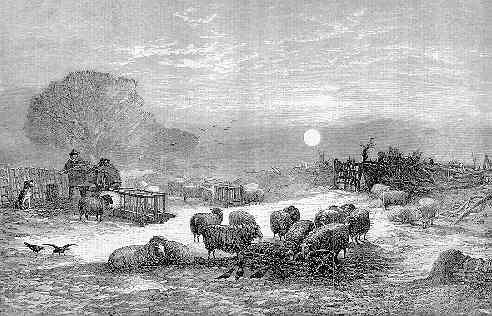
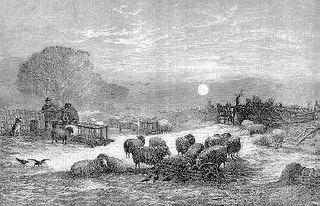
from William Cowper's The Winter Morning Walk, a poem I always think of, my first walk in the snow, any given year--


"The verdure of the plain lies buried deep
Beneath the dazzling deluge; and the bents,
And coarser grass, upspearing o'er the rest,
Of late unsightly and unseen, now shine
Conspicuous, and, in bright apparel clad
And fledg'd with icy feathers, nod superb.
The cattle mourn in corners where the fence
Screens them, and seem half petrified to sleep
In unrecumbent sadness. There they wait
Their wonted fodder; not like hung'ring man,
Fretful if unsupply'd; but silent, meek,
And patient of the slow-pac'd swain's delay.
He from the stack carves out th' accustom'd load,
Deep-plunging, and again deep-plunging oft,
His broad keen knife into the solid mass:
Smooth as a wall the upright remnant stands,
With such undeviating and even force
He severs it away: no needless care,
Lest storms should overset the leaning pile
Deciduous, or its own unbalanc'd weight...."

 Posted by Picasa

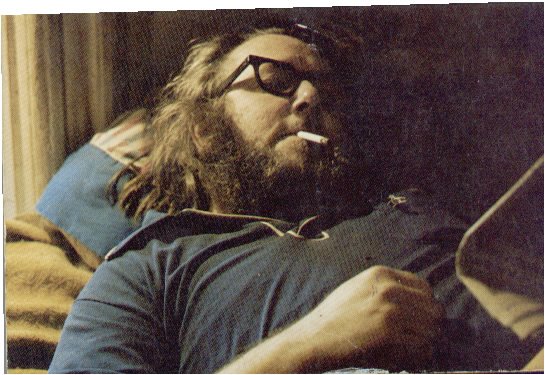
short piece on Mike Kelley doesn't get into the new show, unfortunately, but good anyway--


"I make art," Kelley once said, "in order to give other people my problems."

 Posted by Picasa

From below The Orient, Ayr, as the website has it

"Opened in 1932. Bingo since 1983, then a nightclub, now derelict.
Originally had atmospheric interior; this has been lost."

Across the bridge and across the street from the Carnegie Library--had a very lux interior, blue carpeting with gold flecks but I probably misremember. Was cheaper than the Odeon and there was a threepenny discount for the first eight rows, where I still like to sit.

Posted by Picasa

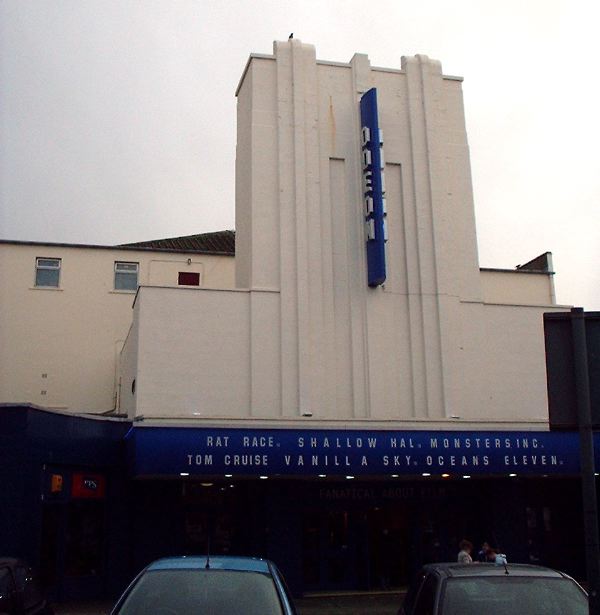
the Odeon in Burns Square, Ayr, fromCinemas in Scotland, subdivided into four now but surviving, saw many movies here, was memorably evacuated from it during a showing of the Rod Steiger "Napoleon", when someone phoned in a bomb scare--'71?? Dad nipped into the pub across the square for a quick one but we were back in our seats in less than half an hour.
 Posted by Picasa

Tuesday, November 29, 2005


Happy Birthday William Blake!

from America: A Prophecy--

"Washington, Franklin, Paine, and Warren, Gates, Hancock, and Green
Meet on the coast glowing with blood from Albion's fiery Prince.
Washington spoke: `Friends of America! look over the Atlantic sea;
A bended bow is lifted in Heaven, and a heavy iron chain
Descends, link by link, from Albion's cliffs across the sea, to bind
Brothers and sons of America; till our faces pale and yellow,
Heads depress'd, voices weak, eyes downcast, hands work- bruis'd,
Feet bleeding on the sultry sands, and the furrows of the whip
Descend to generations, that in future times forget.'
The strong voice ceas'd; for a terrible blast swept over the heaving sea:
The eastern cloud rent: on his cliffs stood Albion's wrathful Prince,
A dragon form, clashing his scales: at midnight he arose,
And flam'd red meteors round the land of Albion beneath;
His voice, his locks, his awful shoulders, and his glowing eyes
Appear to the Americans upon the cloudy night."

Posted by Picasa

thoughtful Ted Berrigan recollections at fait accompli, whose Nick Piombino I met, a fellow floater, amidst the swirl and light of the Mike Kelley show at the Gagosian a couple of weeks back--

"Berrigan was talking about the fact that when we read contemporary poetry there is an *electric* (instantaneous) quality to our contemporary way of reading that is unique to our era. He used Ashbery's Tennis Court Oath as an example. He was saying that we don't stop to think about each word the way we read poetry now. We engulf the pages instantaneously, ravenously. As he spoke about this, he kept pulling on the chord of the electric light hanging from the ceiling over and over turning excitedly turning it on and off. He made me realize that when we read poetry now we read with the speed of light, the speed of thought, so it should be written and presented with this factor in mind. His Sonnets helped make this an era of lightning fast poetry, He also spoke of the loss of nobility in poetry as well, so he was aware of the price that we might be paying for this type of insatiability. But I think he, and the New York School in general, did much to counter the mournful tones of so much 20th Century poetry: ("I grow old, I grow old, I will wear the bottom of my trousers rolled... I have seen them singing each to each...I do not think that they will sing to me")"


 Posted by Picasa

Monday, November 28, 2005


looking forward to Chris (DaVinci) Haddock's Intelligence (with Ian Tracey, pictured) on CBC tonight.

"His goal, Haddock says, was "to do something we don't see much of, which the Brits tend to do, which is an espionage thriller. The Americans do it, but it's often quite cliched; they do an exaggerated action-adventure approach to it. I thought the genre of real espionage thrillers was really unexplored and it would be something fresh.

"I think there's an appetite for it. Just worldwide, you have everybody questioning the sources of information and veracity of information."

Moreover, he envisioned Intelligence as being told from "not the top down but from the bottom up."

Haddock hopes by doing so he can create the sort of topical, potentially incendiary drama that generates conversation " not just thrills " among audience members. Specifically, he references the films of the 1970s " movies that reflected the Watergate era. ""


Posted by Picasa

The Problem With Emily Dickinson from

"Elements of Literature for Christian Schools," by Ronald Horton, Donalynn Hess and Steven Skeggs (Bob Jones University, 2001)

"Several of her poems show a presumptuous attitude concerning her eternal destiny and a veiled disrespect for authority in general. Throughout her life she viewed salvation as a gamble, not a certainty. Although she did view the Bible as a source of poetic inspiration, she never accepted it as an inerrant guide to life."

 Posted by Picasa

Saturday, November 26, 2005


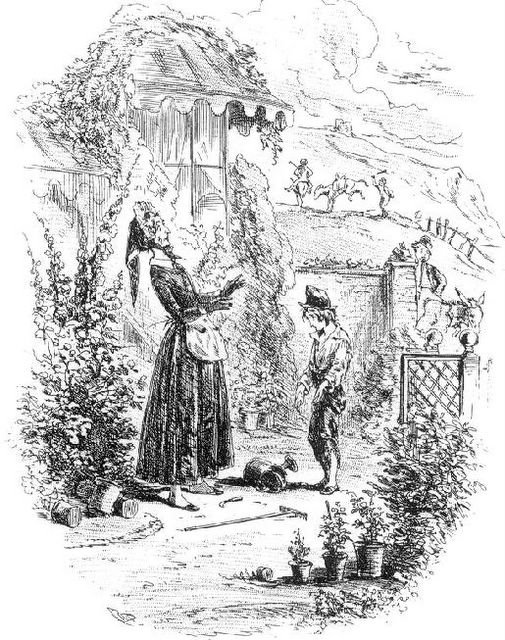
"My shoes were by this time in a woeful condition. The soles had shed themselves bit by bit, and the upper leathers had broken and burst until the very shape and form of shoes had departed from them. My hat (which had served me for a night-cap, too) was so crushed and bent, that no old battered handleless saucepan on a dunghill need have been ashamed to vie with it. My shirt and trousers, stained with heat, dew, grass, and the Kentish soil on which I had slept - and torn besides - might have frightened the birds from my aunt's garden, as I stood at the gate. My hair had known no comb or brush since I left London. My face, neck, and hands, from unaccustomed exposure to the air and sun, were burnt to a berry-brown. From head to foot I was powdered almost as white with chalk and dust, as if I had come out of a lime-kiln. In this plight, and with a strong consciousness of it, I waited to introduce myself to, and make my first impression on, my formidable aunt."

watching George Cukor's great David Copperfield on TCM, how much of movie/text/illustration (as in many cases hopelessly conflated in my mind) was gone, what came back & in what form, intense moments utterly unrelated to narrative, those donkeys on the cliff, Freddie Bartholomew--my Dad's nemesis--and the milestones...


 Posted by Picasa

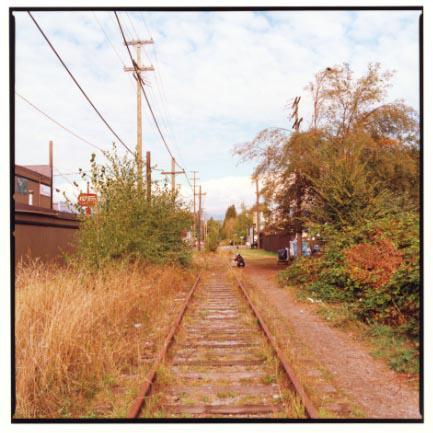
from Mark Mushet at Tyee a very nice set of images (in the warm Burns Bog fire light) of Vancouver's abandoned Arbutus Line--

"The CPR acquired what became known as "The Arbutus Line" from the Vancouver & Lulu Island Railway in 1901. Until 1958, the line was leased to the BC Electric Railway (BCER), which ran passenger services from Vancouver to Steveston. In its time, BCER "Interurban" cars carried people from downtown Vancouver to Steveston. But by 1958, all across North America, rails were replaced by rubber and, eventually, the gridlock we know and love today."

Posted by Picasa

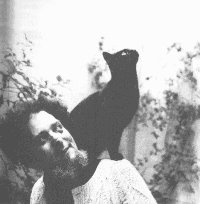
decent Georges Perec piece--Eng. translations of his books gladly all back in print, including Gilbert Adair's "A Void". I was very pleased to meet M. Adair at Lee Ann & Tony's salon, though too shy to subject him to quizzing about one of the most virtuosic translations attempted since Urqhart's Rabelais, let alone his "Love and Death on Long Island". Maybe next time!

Posted by Picasa

Friday, November 25, 2005

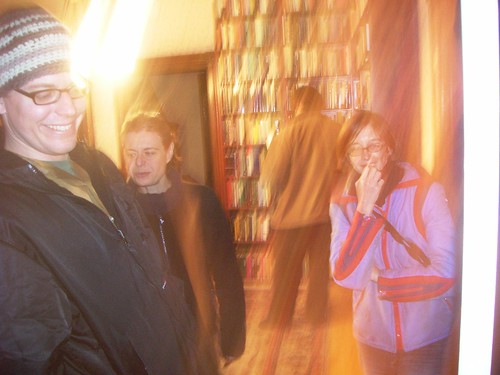
David "Spider" Perry, Carla Billeteri, Me & Monica Fauble in Bangor last week


, originally uploaded by Mongibeddu.

I'm the one gazing wistfully at Ben & Carla's magnificent shelves. Many more of Ben's great pix inside.

Thursday, November 24, 2005

George Monbiot

"But we shouldn't forget that the use of chemical weapons was a war crime within a war crime within a war crime. Both the invasion of Iraq and the assault on Falluja were illegal acts of aggression. Before attacking the city, the marines stopped men 'of fighting age' from leaving. Many women and children stayed: the Guardian's correspondent estimated that between 30,000 and 50,000 civilians were left. The marines treated Falluja as if its only inhabitants were fighters. They levelled thousands of buildings, illegally denied access to the Iraqi Red Crescent and, according to the UN's special rapporteur, used 'hunger and deprivation of water as a weapon of war against the civilian population'.

I have been reading accounts of the assault published in the Marine Corps Gazette. The soldiers appear to have believed everything the US government told them. One article claims that 'the absence of civilians meant the marines could employ blast weapons prior to entering houses that had become pillboxes, not homes'. Another said that 'there were less than 500 civilians remaining in the city'. It continued: 'The heroics [of the marines] will be the subject of many articles and books ... The real key to this tactical victory rested in the spirit of the warriors who courageously fought the battle. They deserve all of the credit for liberating Falluja.'"

Tuesday, November 22, 2005


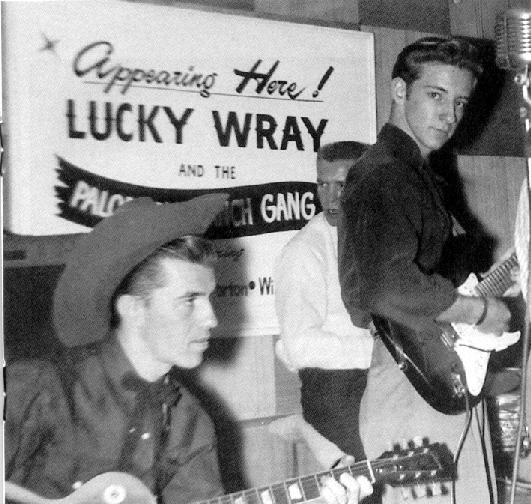
farewell Link Wray (1929-2005). On arrival home a choking fog & now this bad news. I'll be back once a good breeze clears out the valley. Meanwhile: crank it up, daddy.


 Posted by Picasa

Tuesday, November 08, 2005


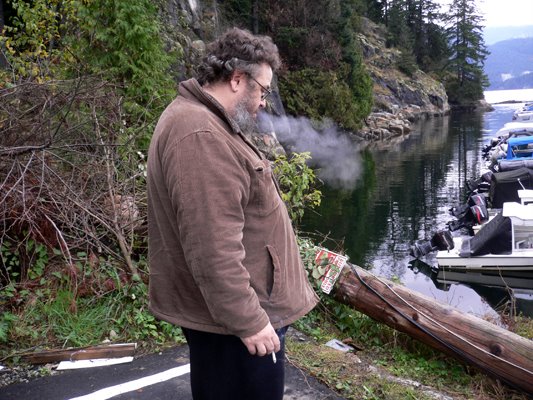
yr humble blogger, in Deep Thought in Deep Cove, one of 365 Sketches by Adam Harrison, the new issue of whose online magazine (co-edited with Aaron Peck) Doppelganger (which contains his fascinating conversation with photographer Evan Lee & a review by Chris Brayshaw) is out.

I will be away from the manse until around the 20th. If you're near the University of Maine in Orono, on the 17th I will be reading with David Perry.

 Posted by Picasa

& also in Vancouver, Meredith Quartermain takes the Macdonald and Knight (which both went past that park I think)--respectively the J & L trains of Vancouver buses--amongst a sheaf of Vancouver-mostly poets ed. by Jacqueline Turner in the new Stylus Poetry Journal--

"The word roars off over the Burrard Bridge, on a route of its own: Harry Knight, a BC photographer, preferred soft-focus pictorial moodiness; John Knight, Captain RN, got his name on the Kwakwakawakw inlet where thousands of first nations people fished for Eulachon (he'd served in the American Revolutionary War with Vancouver's right-hand man, Captain Broughton); The Knights of Labor in the 1880s elected Vancouver's second mayor, lobbied for a shorter work-day, tried to stop the import of low-paid Asian workers. The word roars on through the meccano-set girders of the bridge: a feudal tenant trained for mounted combat; a man devoted to the service of a woman; a horse-head chess-piece that moves in L-shaped leaps. By sea and land we prosper, says the city motto on the bridge house - a lumberjack and a seaman hold up the city coat of arms..."


Posted by Picasa

Christopher Columbus as a bambino, in his old location under the Skytrain tracks at 5th and Clark, a little concrete park on a busy street, always deserted, where I used to like and stop for a smoke and sometimes a wee read while walking between Mount Pleasant and the Drive, now I learn he's in Hastings park, no one told me, from the City of Vancouver Public Art Registry. I had one of the great visions of my life sitting there: foggy, late fall but warm around maybe 3 in the morning, a Skytrain maintenance car, cladded, no windows, grinding the track with festoons of spark hissing into the fog, going back and forth like a floor polisher.


 Posted by Picasa

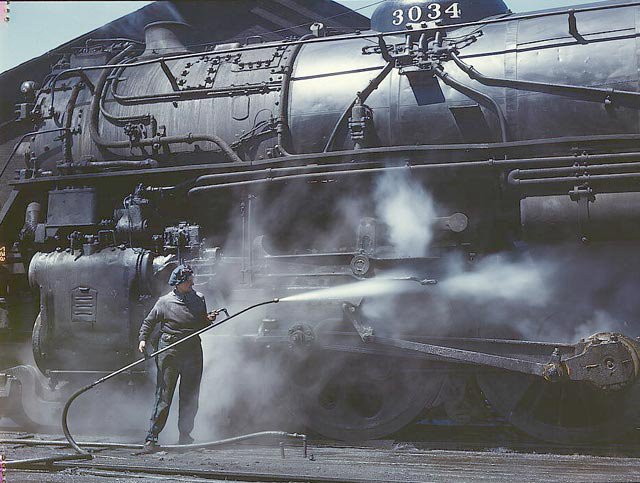
Jack Delano--
"Mrs. Viola Sievers, one of the wipers at the roundhouse giving a giant "H" class locomotive a bath of live steam, Clinton, Iowa, April 1943", from
Bound for Glory: America in Color, 1939-1943 (Library of Congress Exhibition)
 Posted by Picasa

Sunday, November 06, 2005


last night greatly enjoyed Canadian director Fletcher Markle's The Man with a Cloak (1951) with Louis Calhern as the dying roue, Leslie Caron as the ingenue, Barbara Stanwyck as the scheming servant, Jim Backus as the friendly barkeep, a raven named Villon & Joseph Cotten as (spoiler alert!) Edgar Allen Poe...


 Posted by Picasa