Saturday, August 08, 2009


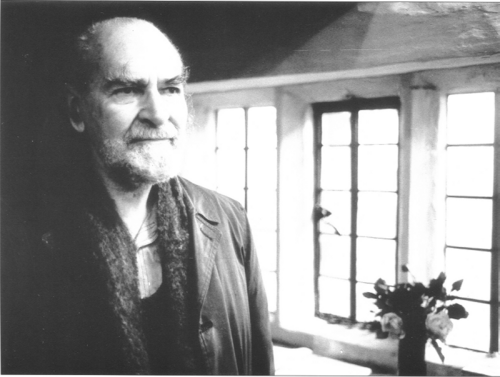
Ed Dorn in the Summer of 1968

“If you went to the Sorbonne, which we did, and, you know, saw the situationistes spilling over the balconies and explaining the L.A. riots, it all made some kind of sense. It was beautifully intellectual and feasible and containable, embraceable … and now it’s so cheap, you couldn’t give it away...”


Friday, August 07, 2009


Vanessa Place
Poetry Magazine was right : I am the law as a lawyer sees it, nothing less than a likeness of being, a set of facts selected from a larger set (itself gleaned from a constellation of actual and fictitious events) and categorized by a codification of conduct, itself categorized from a constellation of possible points of perception. A set of facts, therefore, of being, being thus referencing genre, or medium, thereby referencing nothing more than the means of likeness itself at its point of reception. My linguistic materiality is therefore nothing, and thus, like the American that I am, becomes something. I do not elucidate. I instantiate. I am repetition with variation, the generic affect of which is affectless-ness. There is no disjunction, because there is no juxtaposition. I am everywhere displaced.The question always is whether teleology is possible : whether the deterritorialized creates a new territory. What is the subsumption of the, or the unhinged individual case, of a-judication, of the text as the text, of language as language as nothing more than enunciation? Thierry de Deuve wrote that « Art was a proper name, » meaning that it is only the individual case that calls art into question, and always into question : once work has been deemed art, it operates retrospectively in its subsumption to the rule of art. What has not been written about writing is that in the case of writing, it cannot work subsumptively because it cannot act outside the perception of language in the first instance. Art may be any thing, or nothing at all. It has another point of referentiality—language...


Tuesday, August 04, 2009


To The Motion Picture Production Code on its 75th Birthday

When we look on the pre-Code years (from roughly 1929 to July 1, 1934), we see an American cinema in which actresses are as important or more important than actors, in which love and sex are presented with a certain blithe insightfulness and maturity. Then comes the wrench—and from then on nothing is the same...


...The Code's founders hoped to foster a wholesome culture. All they fostered was a repressed culture, one with neurotic emanations slipping through the cracks. Look at the Marilyn Monroe persona and those of her imitators in the 1950s—the image of woman as oversexed child. For that matter, look at the much more palatable gamine image of Audrey Hepburn in that same decade, the image of woman as asexual child. These are sex symbols for a guilty, prurient, and uncomfortable culture, one nothing like the pre-censorship film culture of the late 1920s and early 1930s...


Monday, August 03, 2009


Why Portland Beats Vancouver

"Anyone who thinks Vancouver is cosmopolitan has never been south or east of Portland," the writer asserted. "Most of Vancouver's other attributes, meanwhile, are seen in better form in either Portland, Seattle, or San Francisco. Spend your time in Victoria instead, or Whistler, or, heck, Nanaimo..."


Friday, July 31, 2009


great article on ANDRE THE GIANT ,though it doesn't mention Samuel Beckett driving him to school.....


Wednesday, July 29, 2009


beat the heat with a bunch of racy pre-code musicals on TCM tonight, including

Hips Hips Hooray (1934)
Gold Diggers of 1933
Footlight Parade (1933) (with James Cagney!
Fashions Of 1934 (with Bette Davis!)


Sunday, July 26, 2009

from The Vehicule Poets
For the Vehicule reading, Gerry pasted pages of poetry across the wall of the space. As the poems were pasted at eye height, he walked along the wall, reading. His poems were... recordings of his thoughts, inner conversations, reflections, self-centered but always in the moment, always coming back to the poem he's thinking, writing. Many of his poems are only a few words, a phrase, out of context, comic aphorisms, a "translation" of Basho's haiku, or the "independently coined" phrase PRONDL, from the "automatic gearshift on your car". His reading is sometimes conversational, sometimes forced out one syllable at-a-time. He was suave, with silk scarf, moustache and sideburns. 1978 and very much alive. Gerry Gilbert...

(polaroid by Lary Bremner)


Friday, July 24, 2009


Ontario, California & Oregon trees

Thursday, July 09, 2009

A century after Swinburne


If Swinburne’s two abiding memories of Eton were Greek prosody and the flogging block, is it surprising that he should have become both a masochist and a master-metrician?


review of  ‘The Age of Wonder’ by Richard Holmes
Much of the book is also devoted to Humphry Davy, whose reputation is multifaceted. He wrote poetry; he had lively friendships with some of the best-known writers of his day; he invented a lamp that would prevent methane gas from exploding and save the lives of countless miners. Best immortalized here, though, are Davy’s experiments with nitrous oxide, tests in which he eagerly served as guinea pig. Inhaling that substance gave him “a thrilling all over me most exquisitely pleasurable,” he recorded. “I said to myself I was born to benefit the world by my great talents...”


Tuesday, July 07, 2009


(cont.)

Orcadian fiddle music survives
in the high arctic

the last latticed leaf
of the HBC's

imperial tree, after
& century & a half the

viking stream
reduced to a trickle

& the rigid tripartite
of the reels stretched like ragas

the better to suit
the long dances

of mid-summer,
loosening by tallow light

messages
in knotted leather.

Monday, July 06, 2009

information about a new edition of Basil Bunting's Briggflatts
which has a CD & a DVD enclosed; they've posted a big bit of the DVD as well...


Sunday, July 05, 2009